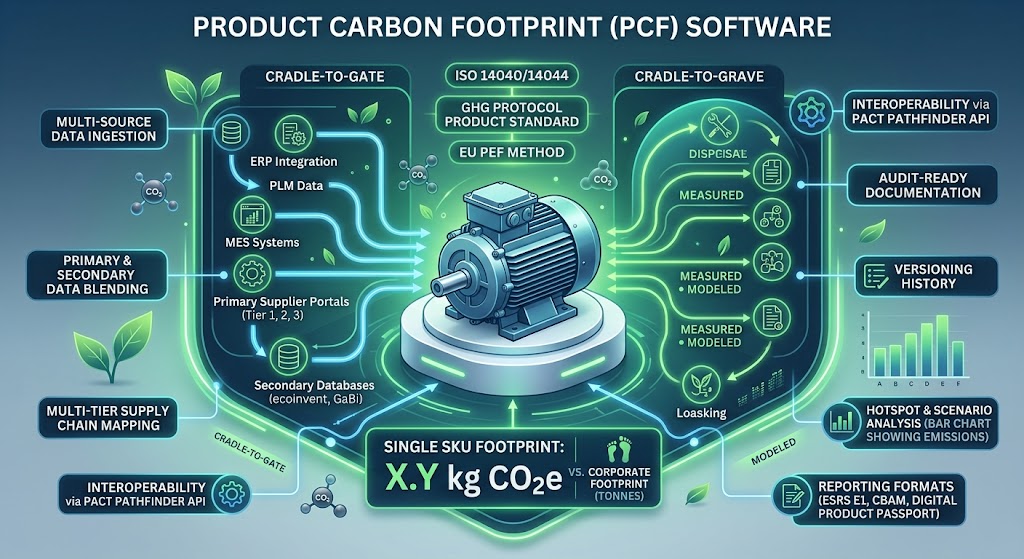
Product carbon footprint (PCF) software calculates the cradle-to-gate or cradle-to-grave greenhouse gas emissions of a single product or SKU, using lifecycle assessment (LCA) methodology aligned with ISO 14040/14044, the GHG Protocol Product Standard, and the EU Product Environmental Footprint (PEF) method. Unlike corporate carbon accounting tools, which total a company’s Scope 1, 2, and 3 emissions, PCF software works at the product level — answering “how many kg CO2e does this specific item generate?” rather than “how many tonnes did the whole company emit this year?”
That distinction matters more in 2026 than it did even two years ago. CSRD-reporting companies now need product-level data to satisfy ESRS E1 disclosures. CBAM (Carbon Border Adjustment Mechanism) requires embedded-emissions data per imported good. Retailers like IKEA and large B2B buyers increasingly ask suppliers for verified PCFs as a condition of doing business. And the EU’s Digital Product Passport, rolling out sector by sector under the Ecodesign for Sustainable Products Regulation (ESPR), will eventually require carbon data to travel with the product itself.
What Is a Product Carbon Footprint, Exactly?
A PCF is the sum of greenhouse gas emissions — expressed in CO2 equivalent — generated across a product’s lifecycle, typically scoped as either:
-
Cradle-to-gate: raw material extraction through the factory gate, before the product leaves for distribution
-
Cradle-to-grave: the full lifecycle including use phase and end-of-life disposal or recycling
Most B2B carbon disclosure today uses cradle-to-gate, since the manufacturer controls that data and the downstream buyer typically calculates use-phase emissions themselves.
Why Companies Are Buying PCF Software Now
Three forces are converging:
-
Regulation: CSRD/ESRS, CBAM, and ESPR are turning product carbon data from a marketing nice-to-have into a compliance requirement with audit trails attached.
-
Supply chain pressure: large buyers are pushing PCF requests down their supplier base — meaning even companies with no direct regulatory obligation are being asked for verified numbers by customers who do.
-
Spreadsheet failure: manual LCA in Excel doesn’t scale past a handful of SKUs, breaks down across multi-tier supply chains, and produces numbers that can’t survive third-party assurance.
What Product Carbon Footprint Software Should Be Capable Of
This is the core capability checklist worth holding any vendor to.
1. Multi-source data ingestion
The software should pull activity data directly from ERP, MES, and procurement systems rather than relying purely on manual spreadsheet uploads. Native connectors to SAP, Oracle, and common PLM tools separate serious platforms from glorified calculators.
2. Primary and secondary data blending
Good PCF tools let a company use primary (supplier-specific) data where available and fall back to high-quality secondary emission factor databases (ecoinvent, GaBi, ELCD, or sector-specific PEFCR datasets) where it isn’t — while clearly flagging which data points are primary vs. secondary, since auditors and buyers increasingly demand that distinction.
3. Multi-tier supply chain mapping
A real PCF requires emissions data from Tier 1, 2, and often Tier 3 suppliers. The software should support supplier portals or data-exchange protocols so upstream partners can submit their own component-level PCFs rather than forcing the buyer to estimate everything top-down.
4. Interoperability via PACT / Catena-X standards
The WBCSD’s Partnership for Carbon Transparency (PACT) and its Pathfinder Network, along with Catena-X in automotive, are emerging as the standard rails for exchanging verified PCF data between companies machine-to-machine. Software that supports PACT Pathfinder API connectivity avoids locking a company into bilateral, non-standard data exchange with every customer and supplier.
5. Methodology compliance and traceability
Every calculation should be traceable back to its methodology — ISO 14040/44, GHG Protocol Product Standard, or PEF — with documented system boundaries, allocation rules, and cut-off criteria. This is what makes a number defensible under assurance, not just internally useful.
6. Hotspot and scenario analysis
Beyond producing a single number, the tool should break down emissions by lifecycle stage and material, identify the largest contributors (“hotspots”), and let teams model the impact of supplier swaps, material substitution, or process changes before committing capital.
7. Audit-ready documentation
With CSRD assurance requirements phasing in, the software needs to generate an evidence trail — data sources, emission factors used, calculation logic, version history — that a limited- or reasonable-assurance auditor can actually follow.
8. Reporting format flexibility
Output needs to map cleanly to ESRS E1 tagging (and eventually XBRL/ESEF for digital filing), CBAM declarations, and ad hoc buyer-specific formats, since large retailers and OEMs often have their own PCF request templates.
9. AI-assisted gap-filling — used carefully
Where primary data is genuinely unavailable, AI can help estimate proxy values from comparable products or historical patterns. The non-negotiable requirement is that every AI-estimated figure is labeled as such, not blended invisibly with primary data, since silent estimation is the fastest way to fail an audit or lose a customer’s trust.
10. Versioning as products and supply chains change
A PCF isn’t a one-time calculation. Supplier changes, material substitutions, and energy mix shifts all move the number. The software should version each PCF and show what changed between calculations, not just overwrite the previous figure.
Common Pitfalls to Avoid When Evaluating Vendors
-
Black-box calculators: if a tool can’t show its emission factor sources and methodology citations, it won’t survive third-party assurance.
-
No supplier data exchange: top-down estimation across multi-tier supply chains produces numbers that look precise but aren’t defensible.
-
Single-format lock-in: a tool built only for one regulation (e.g., only CBAM) will require a second system once CSRD or buyer-specific requests arrive.
-
No primary/secondary data flagging: regulators and auditors increasingly want to know what share of a PCF is measured versus modeled.
Quick Buyer’s Checklist
CapabilityWhy it mattersERP/PLM integrationAvoids manual re-entry and stale dataPACT Pathfinder supportMachine-readable data exchange with partnersISO 14040/44 + GHG Protocol alignmentDefensibility under auditMulti-tier supplier portalReal upstream data instead of estimatesHotspot analysisTurns a number into a reduction planAudit trail / version historyRequired for CSRD assuranceESRS/CBAM-ready exportAvoids duplicate reporting workLabeled AI estimationKeeps primary and modeled data distinguishable
Frequently Asked Questions
What’s the difference between a corporate carbon footprint and a product carbon footprint? A corporate carbon footprint totals a company’s Scope 1, 2, and 3 emissions across all operations for a reporting period. A product carbon footprint isolates the emissions attributable to a single product or SKU across its lifecycle, usually cradle-to-gate.
Is PCF reporting mandatory under CSRD? CSRD itself reports at the company level under ESRS, but ESRS E1 disclosures increasingly require product- and value-chain-level emissions detail, and CBAM separately mandates embedded-emissions reporting per imported product in covered sectors (steel, cement, aluminum, fertilizers, electricity, hydrogen).
What emission factor databases are considered credible for PCF calculations? ecoinvent, GaBi, and the European Reference Life Cycle Database (ELCD) are widely used secondary data sources, alongside sector-specific Product Environmental Footprint Category Rules (PEFCR) datasets where they exist.
Can AI fully automate product carbon footprint calculations? AI can accelerate data collection and fill genuine data gaps with proxy estimates, but credible PCF software keeps AI-estimated figures clearly labeled and separate from primary supplier data, since assurance providers and customers need to know what’s measured versus modeled.
What is the PACT Pathfinder Network? It’s a standard built by the WBCSD’s Partnership for Carbon Transparency for exchanging verified, methodology-consistent PCF data between companies via API, intended to replace one-off bilateral data requests between buyers and suppliers.