The most honest thing a public company publishes is the part nobody reads.
Annual reports run 200+ pages. The marketing lives in the first 20. The truth lives in the risk factors and disclosure sections — where lawyers compel companies to state, in writing and under regulatory scrutiny, what could actually hurt them. Climate exposure. Supply chain dependencies. Governance gaps. It’s all in there. It’s just buried under hundreds of pages of legal language that no human has time to read across more than a handful of companies.
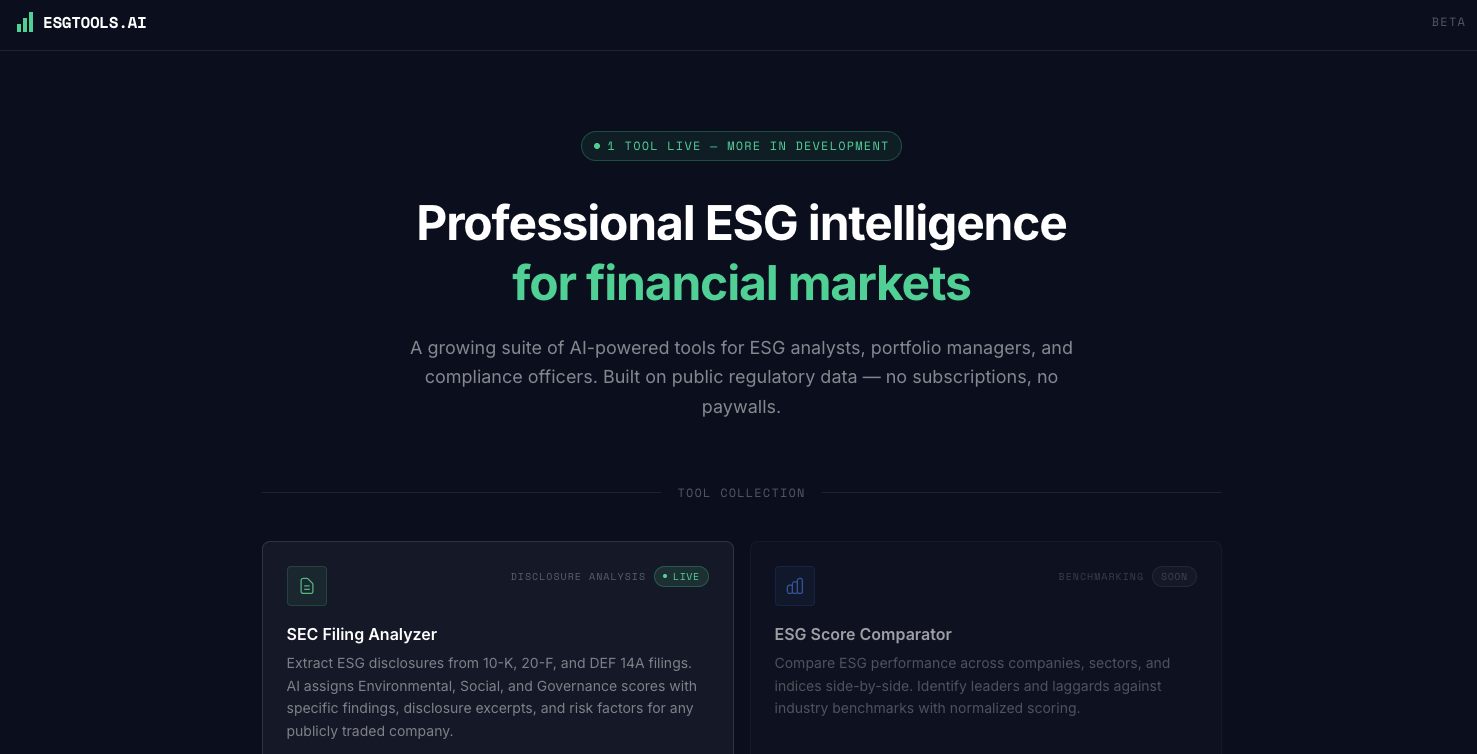
That’s the problem the SEC ESG Analyzer solves: an AI tool to analyze SEC filings for ESG disclosures, built to extract what companies have already told regulators and turn it into structured, scored, citable ESG intelligence.

What the SEC ESG Analyzer Does
Point the tool at any publicly traded company and it reads the company’s regulatory filings the way a senior ESG analyst would — if that analyst had unlimited time and a perfect memory.
The analyzer covers the three filing types where ESG-relevant information actually lives:
-
10-K — the annual report for US-listed companies, including business descriptions, risk factors, and management discussion where environmental and social exposures are disclosed
-
20-F — the equivalent annual filing for foreign private issuers listed on US exchanges, often containing more detailed sustainability context for international companies
-
DEF 14A — the proxy statement, the richest single source for governance data: board composition, executive compensation, shareholder proposals, and oversight structures
From these documents, the AI extracts every ESG-relevant disclosure and delivers four things.
1. Environmental, Social, and Governance scores
Each pillar receives its own score, grounded in what the company has actually disclosed — not in third-party questionnaires, analyst sentiment, or self-reported survey data. The score reflects the depth, specificity, and substance of the disclosures themselves.
2. Specific findings per pillar
Behind every score sits a set of concrete findings: what the company discloses about emissions and climate strategy, how it addresses workforce and human capital topics, what its governance and oversight structures look like. Findings are itemized, not summarized into mush.
3. Disclosure excerpts you can cite
Every finding links to the exact excerpt from the filing that supports it. This is the difference between an AI black box and a research tool you can actually use: when you put a claim in a report, a memo, or an investment note, you can quote the source language and point to where it sits in the filing.
4. Risk factors — in the company’s own words
The risk factors section is where companies confess. The analyzer surfaces the ESG-relevant risks a company has itself admitted to — climate-related operational exposure, regulatory risk, litigation, reputational dependencies — without the surrounding boilerplate.
Why Analyze SEC Filings for ESG Data Instead of Using Ratings?
Most ESG scores on the market are opinions. Ratings agencies blend self-reported questionnaires, media screening, and proprietary analyst judgment — which is why the same company can be rated “leader” by one agency and “laggard” by another. The correlation between major ESG ratings providers is famously weak.
SEC filings are different in kind. They are:
-
Legally binding. Material misstatements in a 10-K carry liability. Marketing decks don’t.
-
Standardized. Every issuer files the same forms on the same schedule, making cross-company comparison meaningful.
-
Complete. Companies must disclose material risks whether or not they’re flattering.
-
Free and public. The data was never missing — the extraction was the bottleneck.
An AI tool to analyze SEC filings for ESG disclosures doesn’t replace ratings with another opinion. It goes one layer beneath them, to the source material the ratings are supposed to be built on.
Who It’s For
Investors and analysts screening portfolios or running diligence get disclosure-grounded ESG profiles in minutes instead of days of manual filing review — with excerpts ready to drop into investment memos.
Sustainability and ESG teams benchmarking against peers can see exactly what competitors disclose, how deeply, and where the gaps are — useful both for reporting strategy and for board conversations.
Researchers, journalists, and students get citable primary-source evidence rather than second-hand scores, with the filing language attached to every claim.
Compliance and risk teams can monitor what counterparties and portfolio companies have formally admitted to regulators, rather than what they put in sustainability brochures.
How to Use It
The workflow is deliberately simple:
-
Open the SEC ESG Analyzer
-
Enter any publicly traded company
-
The AI retrieves and analyzes the relevant 10-K, 20-F, or DEF 14A filings
-
Review the E, S, and G scores, drill into findings, and pull the disclosure excerpts you need
No data uploads, no questionnaire, no integration project. If a company files with the SEC, it can be analyzed.
The Bottom Line
ESG analysis has an extraction problem, not a data problem. Public companies disclose enormous amounts of environmental, social, and governance information every year — under penalty of law — and almost none of it gets read.
The SEC ESG Analyzer turns that buried disclosure into structured intelligence: scores you can defend, findings you can verify, and excerpts you can cite. Companies don’t hide the truth. They file it.
FAQ
What is the SEC ESG Analyzer? It’s an AI tool to analyze SEC filings for ESG disclosures. It reads 10-K, 20-F, and DEF 14A filings for any publicly traded company and extracts ESG findings, assigns Environmental, Social, and Governance scores, and surfaces disclosure excerpts and risk factors.
Which SEC filings does it analyze? The 10-K (US annual report), the 20-F (annual report for foreign private issuers), and the DEF 14A (proxy statement) — the three filings where most ESG-relevant disclosure is concentrated.
How are the ESG scores calculated? Scores are grounded in the company’s actual regulatory disclosures — their depth, specificity, and substance — rather than self-reported questionnaires or analyst opinion. Every score is backed by itemized findings linked to filing excerpts.
Can I verify the AI’s findings? Yes. Each finding includes the specific disclosure excerpt from the filing that supports it, so every claim is traceable to the primary source.
Which companies can be analyzed? Any publicly traded company that files with the SEC — including foreign issuers listed on US exchanges via the 20-F.