At least 75 U.S. data center projects worth about $130 billion were blocked or delayed in the first quarter of 2026 alone, a figure that matched all of 2025.
Key Takeaways
- According to Tom’s Hardware, citing Data Center Watch, at least 75 projects worth roughly $130 billion were blocked or delayed in Q1 2026.
- Gartner forecasts global data center electricity consumption will reach 565 TWh in 2026, up 26% year over year from 447 TWh in 2025.
- Gartner also says AI-optimized servers will account for 31% of data center power consumption in 2026 and surpass conventional servers in power use in 2027.
- Axios reported on June 11 that Amazon says it is 75% of the way to its 2030 water replenishment goal for data centers and claims its facilities are seven times more water-efficient than the industry average.
The real AI sustainability fight has moved to local permitting
The most important AI sustainability story this week is not a new model, a new pledge, or a new emissions estimate. It is that local governments and communities are starting to exercise veto power. That changes the center of gravity for the AI economy.
For two years, the public debate around AI sustainability has been dominated by abstract questions: how much energy training runs consume, whether inference will outgrow training, and whether voluntary corporate targets can keep pace with compute demand. Those questions still matter. But the more immediate constraint is more practical: can a project get approved, connected, cooled, and politically defended?
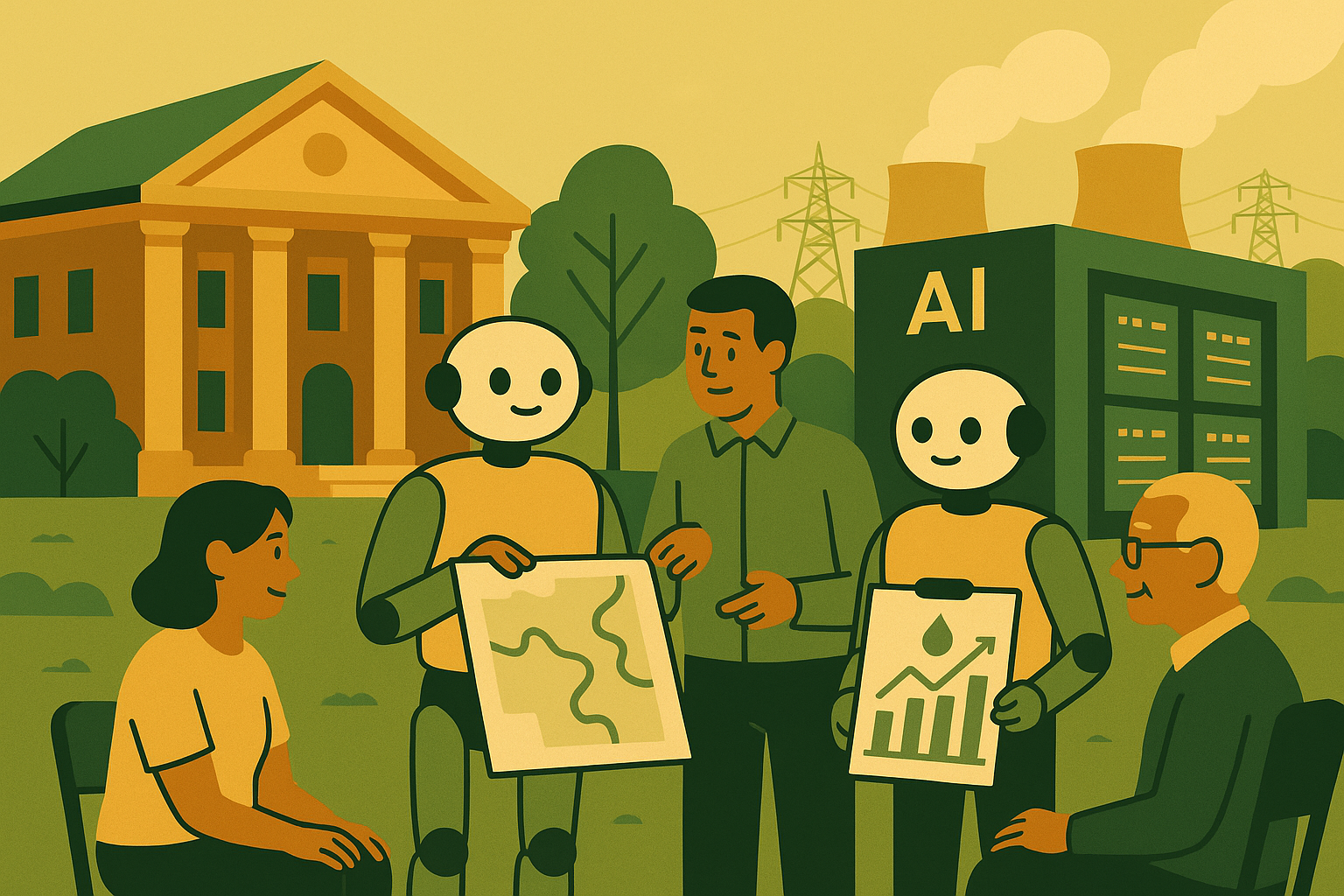
According to Tom’s Hardware, citing Data Center Watch, at least 75 U.S. data center build-outs worth around $130 billion were blocked or delayed in the first quarter of 2026. The same report says 69 local government units had enacted bans as of May 2026, while Seattle recently approved a one-year pause on new projects. Even if you discount some of the rhetoric surrounding individual fights, the broader signal is unmistakable: AI infrastructure now faces the same kind of place-based resistance that energy, mining, transmission, and housing developers have dealt with for years.
This is why green data center strategy can no longer be treated as a branding exercise. It is becoming a license-to-operate issue.
Power demand is no longer a side effect of AI growth. It is the bottleneck.
The timing of the local backlash matters because it coincides with new evidence that power demand is accelerating faster than most corporate sustainability teams can absorb. Gartner said on June 10 that global data center electricity consumption is projected to hit 565 TWh in 2026, up 26% from 447 TWh in 2025. It also projects worldwide data center power demand to reach 132 GW in 2026, up from 104 GW in 2025.
Those numbers matter not because they are shocking on their own, but because they shift the planning baseline. A 26% annual jump in electricity consumption is not something utilities, regulators, and communities will interpret as business as usual. It turns AI expansion into a system-planning problem. And once that happens, the conversation broadens beyond carbon intensity to include interconnection queues, backup generation, substation capacity, ratepayer equity, and which loads get priority.
Gartner adds that AI-optimized servers will account for 31% of data center power consumption in 2026 and that their power use will overtake conventional servers in 2027. That is a crucial threshold. It means the sustainability burden of AI is no longer hidden inside a larger digital infrastructure category. AI is becoming visible enough, distinct enough, and concentrated enough to be regulated and contested as its own class of demand.
That should force a rethink of how companies frame AI expansion to external stakeholders. The old message was efficiency: chips are improving, models are getting better, software is optimizing workloads. The new reality is allocation: who gets scarce power first, on what terms, and with what local benefits?
Water is becoming the politically salient metric
Carbon still dominates sustainability reporting, but local politics often runs on more immediate concerns. Water is one of them. That is why recent corporate messaging has shifted so visibly toward cooling efficiency and replenishment.
On June 11, Axios reported that Amazon said it was 75% of the way toward its 2030 goal to replenish more water into communities than its data centers consume, and that the company says its data centers are seven times more water-efficient than the industry average. Whatever one thinks of those claims, the strategic point is clear: hyperscalers are trying to move upstream of a legitimacy problem.
Why? Because once residents believe a project may increase their bills, strain local water systems, add diesel backup emissions, and create few visible community benefits, the developer is fighting a narrative it probably cannot reverse with sustainability microsites and annual reports.
This is where AI companies have repeatedly underestimated the politics of infrastructure. They assumed opposition would track ideology. Instead, the resistance is proving bipartisan and practical. Households care about rates, noise, land use, groundwater, and who captures the upside. They are not asking whether a model is frontier-grade. They are asking why their town should absorb the externalities.
For sustainability leaders, that means AI water footprint reporting must become more location-specific. Aggregate global water metrics will not settle local permitting disputes. Communities want watershed-level disclosure, seasonal risk context, and credible operating scenarios under drought or heat stress.
The permitting era will reward developers who can prove public value
One reason the current backlash matters is that it reveals a widening gap between corporate and civic definitions of sustainability. For many companies, sustainability still means lower PUE, cleaner procurement, or improved disclosure. For communities, sustainability means something simpler: lower harm and shared benefit.
That difference explains why technically efficient projects can still fail politically. A developer may have a strong renewable procurement strategy and high-performance cooling design, yet still lose because residents do not see enough jobs, tax gains, resilience investment, or environmental safeguards to justify the footprint.
The next phase of AI infrastructure development will therefore favor operators that can show four things before opposition hardens. First, a credible power plan that does not simply socialize infrastructure costs onto existing customers. Second, a water plan tied to regional conditions rather than generic efficiency claims. Third, a community benefit case that survives scrutiny. Fourth, auditable disclosure that can be examined by regulators, utilities, and civil society without reverse-engineering the company’s PR language.
This is exactly where sustainability and AI governance begin to merge. The key capability is not just measurement. It is governable evidence.
Why this is bigger than data centers
The deeper implication is that AI sustainability has entered an era of physical accountability. The sector can no longer behave as though social acceptance will follow technical progress by default.
That matters far beyond the data center category. It will shape corporate AI deployment decisions, site selection strategy, cloud pricing, clean energy procurement, and even model architecture choices. If the marginal cost of new compute now includes political friction, legal delay, and community concessions, then the economics of scaling AI change.
It also changes what serious sustainability leadership looks like. The winners will not be the firms with the most polished AI ethics language or the broadest net-zero claim. They will be the ones that can align compute growth with grid realities, water constraints, and local consent. Expect stronger demand for AI energy governance frameworks, more public scrutiny of siting decisions, and tougher questions from investors about whether infrastructure pipelines are actually buildable.
What This Means for Sustainability Leaders
If you lead sustainability, infrastructure, real estate, or digital strategy, treat community acceptance as a first-order operating variable. The issue is no longer whether AI has an environmental footprint. The issue is whether your organization can document that footprint well enough, reduce it fast enough, and distribute value fairly enough to keep projects moving. Companies that integrate energy planning, water stewardship, permitting strategy, and public disclosure will have a real advantage. Companies that treat sustainability as an after-the-fact communications function will discover that the project pipeline can fail long before an annual report is published.
Frequently Asked Questions
Why are AI data center moratoriums increasing in 2026?
Local opposition is rising because AI facilities are now large enough to affect electricity demand, water use, land use, noise, and perceived utility costs. As projects scale, communities are pushing elected officials to slow approvals until rules catch up.
How much electricity will data centers use in 2026?
Gartner forecasts global data center electricity consumption will reach 565 TWh in 2026, up 26% from 447 TWh in 2025. That growth rate is one reason AI infrastructure is becoming a grid planning issue rather than just a technology issue.
Is water now a bigger issue than carbon for AI data centers?
In local permitting fights, often yes. Carbon matters for enterprise reporting and investor scrutiny, but water tends to be more immediate and politically visible for host communities, especially in stressed regions.
Want sharper analysis on AI infrastructure, climate risk, and sustainability regulation? Follow SustainabilityAGI for daily coverage that connects compute growth to the real constraints shaping the next phase of the AI economy.