Carbon accounting used to be an annual spreadsheet exercise. A sustainability manager chased invoices, applied emission factors by hand, and produced a PDF that nobody could audit and few people read.
That model is dead. Regulators now expect audit-grade emissions data across Scope 1, 2 and 3. Customers embed carbon clauses in procurement contracts. Investors screen on decarbonization trajectories, not pledges. And the volume of data required — energy bills, fuel records, supplier invoices, logistics manifests, product-level material data — has outgrown what any human team can process manually.
This is the gap AI carbon accounting closes. In this guide, we explain what it is, how it actually works under the hood, why 2026 is the inflection point, and how to evaluate AI carbon accounting software for your organization.
What Is AI Carbon Accounting?
AI carbon accounting is the use of artificial intelligence — primarily machine learning and large language models — to automate the measurement, classification, calculation and reporting of an organization’s greenhouse gas emissions.
Traditional carbon accounting follows the GHG Protocol: collect activity data, match it to emission factors, calculate CO₂e, and disclose. The methodology hasn’t changed. What AI changes is the execution:
-
Data ingestion: AI extracts activity data directly from unstructured sources — utility bills, fuel receipts, freight invoices, ERP exports — instead of relying on manual entry.
-
Classification: Machine learning maps thousands of spend and procurement line items to the correct emission categories and factors automatically.
-
Gap detection: Models flag missing data, anomalies and double counting before an auditor does.
-
Disclosure drafting: LLMs assemble framework-aligned narrative and quantitative disclosures (ESRS E1, IFRS S2, CDP) from the underlying data.
The result is a shift from carbon accounting as a once-a-year project to carbon accounting as continuous infrastructure — closer to financial accounting than to reporting theater.
Why 2026 Is the Tipping Point for AI and Carbon Accounting
Three regulatory forces converged this year, and each one multiplies the data burden.
1. CSRD after Omnibus I: fewer companies, higher stakes
The EU’s Omnibus I package narrowed the CSRD’s scope to large companies (1,000+ employees and €450M+ turnover thresholds), cutting the number of in-scope firms dramatically. Counterintuitively, this raised the bar: the companies that remain in scope are exactly the ones with the most complex value chains, and ESRS E1 requires gross Scope 1, 2 and 3 disclosure with assurance. There is no “small company” excuse left in the room.
2. CBAM’s definitive period
The Carbon Border Adjustment Mechanism entered its definitive phase in 2026. Importers of covered goods into the EU must now calculate and pay for embedded emissions across their supplier base. That means systematically collecting supplier-level emissions data at a scale that manual processes simply cannot handle — a problem tailor-made for AI-driven carbon accounting software with supply chain tracking.
3. Scope 3 gets teeth
The GHG Protocol’s 2026 Scope 3 revisions introduced stricter expectations around data quality and disaggregation, and jurisdictions from California (SB 253) to the GCC are moving toward mandatory value-chain disclosure. Scope 3 typically represents 70–90% of a company’s footprint and depends almost entirely on third-party data — messy, inconsistent, and arriving in a hundred formats. This is where AI for carbon accounting earns its keep.
How AI Carbon Accounting Software Actually Works
Strip away the marketing and most platforms run a five-stage pipeline.
Stage 1: Automated data collection
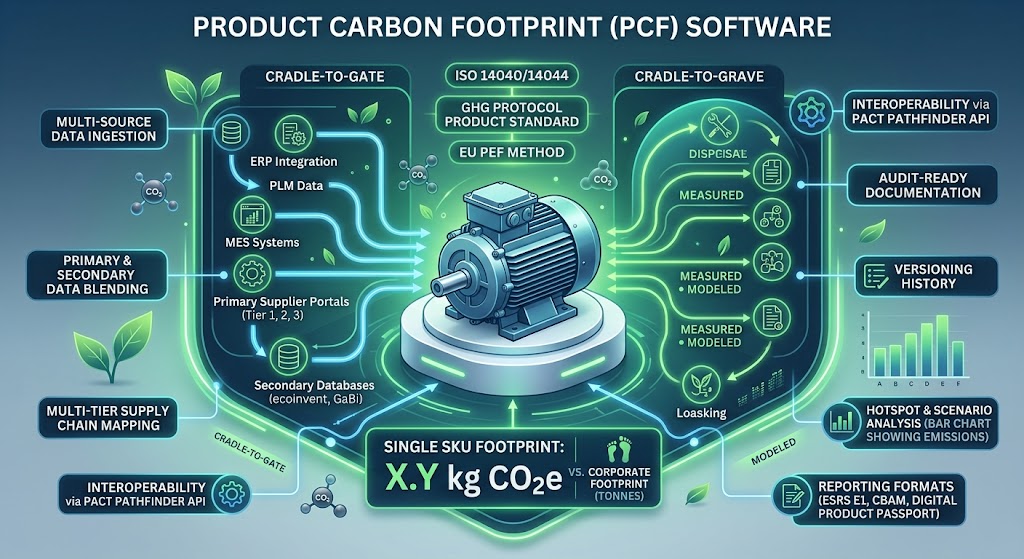
The platform connects to your ERP, accounting system, utilities, travel tools and procurement data. Documents that can’t be integrated — PDF invoices, supplier questionnaires, freight manifests — are parsed by AI document extraction. What previously took a sustainability team months of chasing now happens continuously in the background.
Stage 2: Intelligent classification
Every transaction and activity record is classified against the correct GHG Protocol category and matched to an emission factor from databases covering tens of thousands of factors. Machine learning models trained on millions of classified line items do in seconds what consultants used to bill weeks for — and they improve with every correction.
Stage 3: Calculation with data lineage
CO₂e is calculated with full traceability: every figure in the final report links back to its source document, factor and methodology. This audit trail is the difference between AI as a black box (which assurance providers reject) and AI as accounting infrastructure (which they increasingly expect).
Stage 4: Supply chain emissions tracking
For Scope 3, the platform combines supplier-reported primary data, spend-based estimates and activity-based modeling — and tells you which is which. AI prioritizes which suppliers to engage first based on emissions materiality, then automates the outreach, data validation and follow-up.
Stage 5: Disclosure generation
Finally, the platform maps validated data into the frameworks you report under — ESRS, IFRS S2, CDP, GRI, or national schemes — and drafts the disclosure itself. One dataset, many output formats. This is what “ESG strategy digitalization” means in practice: the report becomes a byproduct of good data, not a heroic annual effort.
AI vs. Traditional Carbon Accounting Consulting
Does AI carbon accounting replace carbon accounting consulting? Not exactly — it changes what consulting is for.
Traditional consulting-ledAI-native platformData collectionManual, email-and-spreadsheetAutomated ingestion and extractionSpeed3–6 months per cycleContinuous, near real-timeCost structureRecurring project feesSoftware subscriptionScope 3 depthSampled, estimate-heavyFull-population, supplier-levelAudit trailReconstructed afterwardsBuilt in from the first data pointStrategyConsultant-dependentData-driven, but still needs human judgment
The honest answer: AI eliminates the low-value 80% of consulting work — data wrangling, factor matching, formatting. What remains valuable is the strategic 20%: decarbonization roadmaps, target setting, materiality judgment, and navigating regulatory grey zones. The best setups pair an AI-native platform with expert oversight, whether in-house or external.
What About Blockchain?
The “AI + blockchain” pairing comes up constantly in ESG digitalization discussions, so it deserves a straight answer.
Blockchain has a narrow but real role: immutability and provenance. Carbon credit registries, product passports and supplier attestations benefit from tamper-proof records, and the EU’s Digital Product Passport push will likely expand that use case. But blockchain doesn’t solve carbon accounting’s core problem — getting accurate data in the first place. A wrong number on a blockchain is just a wrong number you can’t edit.
Prioritize accordingly: AI solves data collection and quality (the 95% problem); blockchain addresses verification and transferability (the 5% problem). Be skeptical of any vendor leading with the latter.
How to Evaluate AI Carbon Accounting Software: 7 Questions
-
Can it show its work? Every calculated figure should trace back to source data, emission factor and methodology. No lineage, no assurance.
-
How does it handle Scope 3? Ask specifically about supplier engagement workflows, primary data collection, and how spend-based estimates are upgraded over time.
-
Which frameworks does it natively support? ESRS/CSRD, IFRS S2, CDP and CBAM at minimum if you operate in or sell into the EU.
-
What does the AI actually do? “AI-powered” can mean anything from genuine ML classification to a chatbot bolted onto a spreadsheet. Ask for the specific automation steps and their accuracy rates.
-
Is human review built in? Audit-grade AI carbon accounting keeps humans in the loop for material judgments — fully autonomous black boxes fail assurance.
-
How fast is implementation? AI-native platforms should onboard in weeks, not the quarters legacy enterprise software requires.
-
Does it scale across jurisdictions? If you report in the EU and operate in the GCC, Asia or the US, one dataset should feed every regime.
The Bottom Line
Carbon accounting is becoming what financial accounting became decades ago: continuous, automated, audited and strategic. AI is the technology making that transition possible at the exact moment regulation makes it mandatory.
Companies that treat AI carbon accounting as infrastructure — not as a compliance checkbox — get a second dividend: the same data that satisfies regulators reveals where energy, logistics and procurement costs hide. Decarbonization and margin improvement turn out to be the same analysis.
Coral is an AI-native ESG and sustainability reporting platform built for exactly this shift — automated emissions data collection, CSRD/ESRS-aligned disclosure, and supply chain transparency, without the spreadsheet archaeology. Book a demo to see your first audit-ready emissions inventory in weeks, not months.
FAQ
What is AI carbon accounting? AI carbon accounting uses machine learning and large language models to automate the collection, classification, calculation and reporting of greenhouse gas emissions across Scope 1, 2 and 3 — turning a manual annual exercise into continuous, audit-ready data infrastructure.
Is AI carbon accounting accurate enough for audits? Yes, provided the platform maintains full data lineage — every figure traceable to its source document and emission factor — and keeps human review in the loop for material judgments. Assurance providers reject black-box outputs but increasingly expect AI-assisted pipelines.
Does AI carbon accounting replace consultants? It replaces the data-wrangling majority of consulting work. Strategic advisory — decarbonization roadmaps, target setting, regulatory interpretation — remains a human discipline, now powered by better data.
How does AI help with Scope 3 emissions? AI automates supplier data collection, classifies procurement spend against emission categories, fills gaps with modeled estimates, and flags which estimates to upgrade to primary data first based on materiality.
What regulations require carbon accounting in 2026? Key regimes include the EU’s CSRD (as amended by Omnibus I), CBAM’s definitive period, IFRS S2 adoption across multiple jurisdictions, and California SB 253 — most requiring full Scope 1–3 disclosure with assurance.